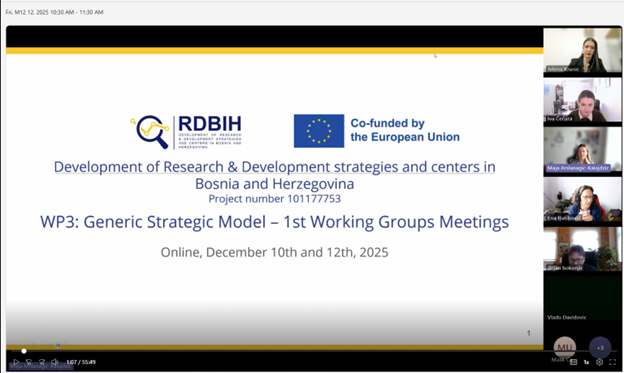
Within the implementation of Work Package 3 (WP3) of the RDBiH project, a series of meetings of four thematic working groups were orchestrated by University of Sarajevo and held in December 2025, aiming to collect key inputs for the development of the Generic Strategic Model (GSM) for research and development (R&D) in Bosnia and Herzegovina.
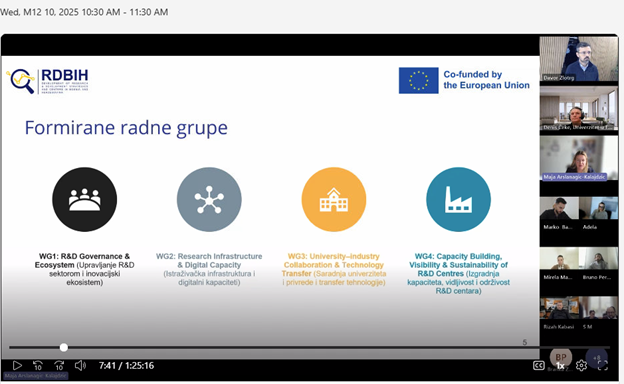
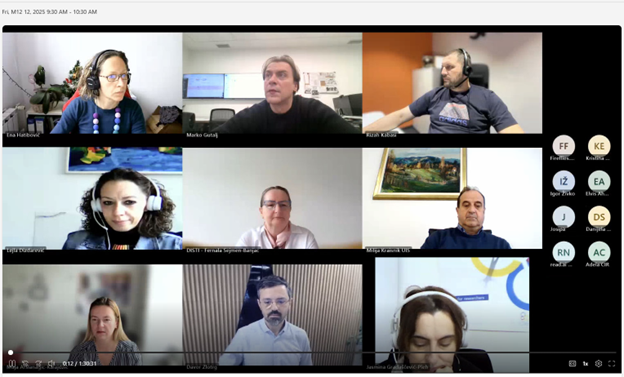
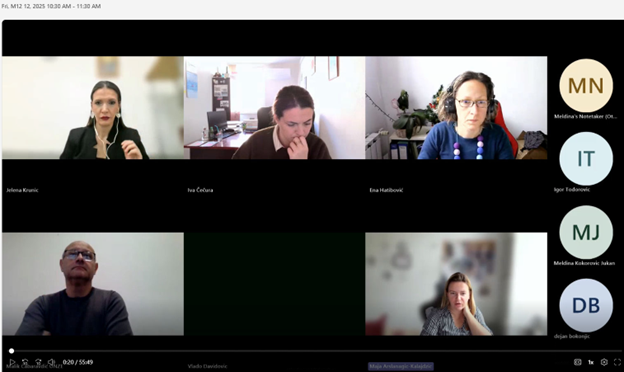
On 10 December 2025, online meetings of WG1 – R&D Governance & Ecosystem and WG2 – Research Infrastructure & Digital Capacity were held, followed by meetings of WG3 – University–Industry Collaboration & Technology Transfer and WG4 – Capacity Building, Visibility & Sustainability of R&D Centres on 12 December 2025. The meetings gathered representatives of all project partners, as well as representatives of focal universities, relevant ministries at the entity and cantonal levels, companies and other stakeholders from the R&D ecosystem.
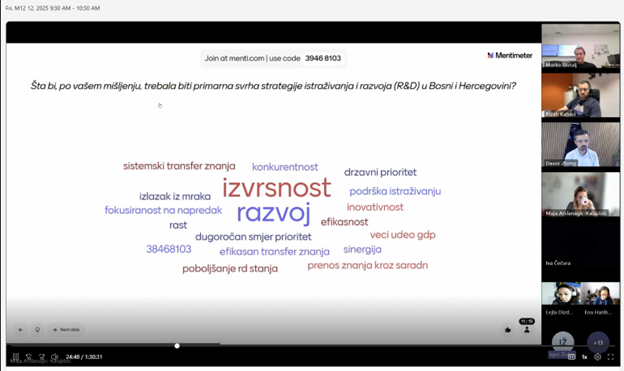
Through a combination of an introductory presentation and interactive discussion, participants addressed key elements of future R&D strategies, including the purpose of the strategy, the vision for the development of the R&D system, main strategic objectives, and a SWOT analysis of the current state of the R&D sector from the perspective of each thematic area. Particular emphasis was placed on exchanging experiences, identifying common challenges and opportunities, and ensuring greater alignment of strategic approaches across different administrative levels in Bosnia and Herzegovina.
The outcomes and conclusions of the working group meetings represent a crucial contribution to the implementation of WP3 activities and will serve as an analytical and conceptual basis for the development of the Generic Strategic Model (GSM). The GSM is envisaged as an overarching strategic framework that can be adapted for the preparation of R&D strategies at the level of entities, cantons, and universities across Bosnia and Herzegovina.
Work on WP3 activities will continue in the coming period through further analysis of the collected inputs, preparation of the GSM draft, and the organisation of additional consultative activities with key stakeholders and policy makers.